Benefits Of Daily Meditation For Anxiety
The benefits of daily meditation for anxiety are more concrete than most people expect — and more accessible than the idea of sitting cross-legged for an hour might suggest. If you’re a student cramming for exams or a professional managing back-to-back meetings, anxiety probably shows up in your life as racing thoughts, tension in your shoulders, or that low-grade dread that follows you around. Meditation is not a cure-all, but the research behind it is solid enough to take seriously. This article breaks down exactly what daily meditation does for anxiety, how to build the habit, and what you can realistically expect.
What anxiety actually does to your brain
Anxiety is not just a feeling — it is a physiological response. When your brain perceives stress, the amygdala (your brain’s alarm system) fires up and triggers the release of cortisol and adrenaline. That is useful if you are running from a threat. It is less useful when the threat is an unread email at 11 PM.
Chronic anxiety keeps your nervous system in a low-level state of alert. Over time, this wears down your ability to concentrate, disrupts your sleep, and can contribute to physical symptoms like headaches and digestive issues. Understanding this helps explain why meditation works — because it directly targets the brain’s stress response rather than just masking the symptoms.
The science behind meditation and anxiety relief
According to a 2023 meta-analysis published in JAMA Internal Medicine, mindfulness meditation programs showed a moderate but consistent reduction in anxiety symptoms across a wide range of adult populations, with effects comparable to those of some antidepressant medications. That is not a small finding.
What is happening neurologically is worth understanding. Regular meditation practice has been shown to reduce the size and reactivity of the amygdala over time. It also strengthens the prefrontal cortex — the part of your brain responsible for rational thinking and emotional regulation. In simple terms, meditation helps your brain get better at noticing anxious thoughts without immediately being hijacked by them.
Researchers at Harvard found that just eight weeks of mindfulness practice produced measurable changes in brain gray matter. You do not need years of practice to start seeing results. Most people report a noticeable shift in their anxiety baseline within two to four weeks of consistent daily meditation.
Why daily practice matters more than duration
One of the most common mistakes people make is trying to meditate for 30 minutes once a week rather than 10 minutes every day. Frequency beats duration when it comes to building the neural pathways that reduce anxiety. Think of it like exercise — a short walk every day is more effective for cardiovascular health than one long run on Saturday.
The brain learns through repetition. Each time you sit down, notice your thoughts without engaging them, and return your attention to your breath, you are reinforcing a mental habit. Over days and weeks, that habit starts to transfer into your regular life. You become slightly better at catching the spiral before it starts.
Even five minutes counts. Apps like Insight Timer and Calm have free options, and there are thousands of guided sessions on YouTube. The format matters less than showing up consistently.
Specific benefits you can expect
Here is what the research and real-world experience suggest you will notice with consistent daily meditation:
- Reduced physical symptoms of anxiety, including lower resting heart rate and slower, deeper breathing patterns
- Better sleep quality, because an overactive mind is one of the main drivers of insomnia
- Improved focus and working memory, since anxiety consumes cognitive bandwidth that becomes available when you are calmer
- More emotional space between a trigger and your reaction — you notice the feeling before acting on it
- Lower cortisol levels over time, which has downstream benefits for energy, immune function, and mood
- A greater sense of control, which is itself anxiety-reducing because helplessness amplifies stress
How to start a daily meditation practice (even if you’ve tried before)
Most people quit meditation not because it is hard, but because they set up the conditions for failure. Here is a straightforward approach that actually sticks:
- Pick one fixed time. The best time is right after an existing habit — after your morning coffee, before you open your laptop, or right before bed. Attaching meditation to something you already do removes the decision-making friction.
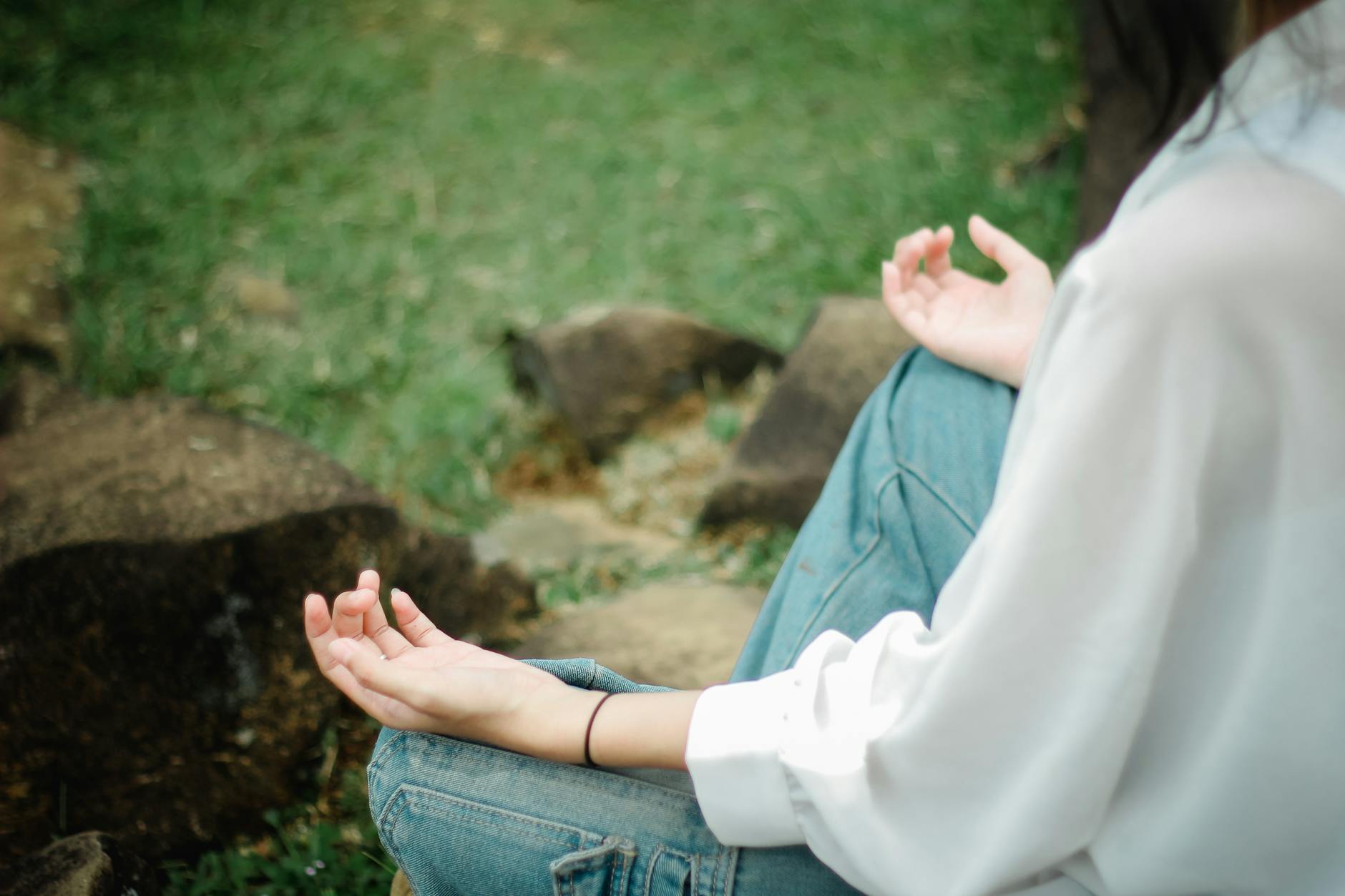
- Start with five minutes, not twenty. Set a timer for five minutes. Sit somewhere reasonably quiet, close your eyes, and focus on your breath. When a thought appears — and it will — notice it, let it pass, and return to your breath. That is the entire practice.
- Use a guided session for the first two weeks. Apps and audio guides reduce the temptation to peek at the clock or wonder if you’re doing it right. Good starting options include the free sessions on Insight Timer or the Headspace basics course.
- Track it somewhere visible. A simple habit tracker on your phone or a paper calendar with an X for each completed session uses a principle from behavioral psychology called the “chain method” — you become motivated to not break the streak.
- Expect distraction and plan for it. The goal of meditation is not to stop thoughts. It is to notice them without following every one. If you spend a session chasing thoughts and returning your focus fifty times, that is fifty repetitions of the skill. That is a good session.
- Adjust the format if something isn’t working. Not everyone connects with breath-focused meditation. Body scan meditations, walking meditations, and open awareness practices are all evidence-backed alternatives. The method is less important than the regularity.
Common mistakes that slow progress
A few patterns tend to derail people who are otherwise doing the right things:
- Judging the quality of each session. Some will feel calm and focused. Others will feel scattered. Both are normal and both are useful.
- Expecting immediate dramatic results. Anxiety built up over years does not dissolve in a week. The change is gradual, and you will often notice it in retrospect — realizing you handled something stressful better than you would have before.
- Meditating only when anxious. This turns meditation into a fire extinguisher rather than a training system. Daily practice when you’re already calm is what builds the capacity to stay calm under pressure.
- Skipping days without restarting. Missing a day is fine. Missing a week and concluding you’ve “failed” is the real problem. The habit resets from wherever you pick it up again.
Frequently Asked Questions
How long does it take for meditation to reduce anxiety?
Most people notice some shift in their anxiety levels within two to four weeks of daily practice, even with sessions as short as five to ten minutes. More significant changes in baseline anxiety tend to appear after six to eight weeks, which aligns with what the neuroscience research on brain plasticity suggests. Results vary depending on the severity of your anxiety, your consistency, and whether you’re using other tools like therapy or exercise alongside meditation.
Can meditation replace therapy or medication for anxiety?
Meditation is an evidence-backed tool for managing anxiety, but it is not a clinical treatment and should not be positioned as a substitute for professional care if your anxiety is significantly interfering with your daily life. For mild to moderate anxiety, meditation can be highly effective on its own or as part of a broader wellness routine. For severe or clinical anxiety disorders, it works best as a complement to therapy or medical treatment, not a replacement.
What type of meditation is best for anxiety?
Mindfulness-based stress reduction (MBSR) has the strongest body of research behind it for anxiety specifically. Within mindfulness practice, both breath-focused meditation and body scan techniques have shown consistent results. If traditional seated meditation feels inaccessible, mindful walking and progressive muscle relaxation are good entry points that still activate the same neural pathways. The best type is the one you will actually do consistently.
Final thoughts
Daily meditation is not complicated, but it does require honesty about one thing: the benefits are built through repetition, not intention. Reading about it, even thoroughly, does not produce the changes in your brain that practice does. If you have been meaning to start, the practical entry point is this: tomorrow morning, before you check your phone, set a five-minute timer and focus on your breath. A 2022 study published in Science Advances found that even a single ten-minute mindfulness session reduced state anxiety in participants with no prior meditation experience — so your first session is not wasted time.